A Park Visit Built Around Noticing, Not Distance
A park visit built around noticing helps you see familiar places afresh through sound, texture, and everyday activity, without needing a route or destination.
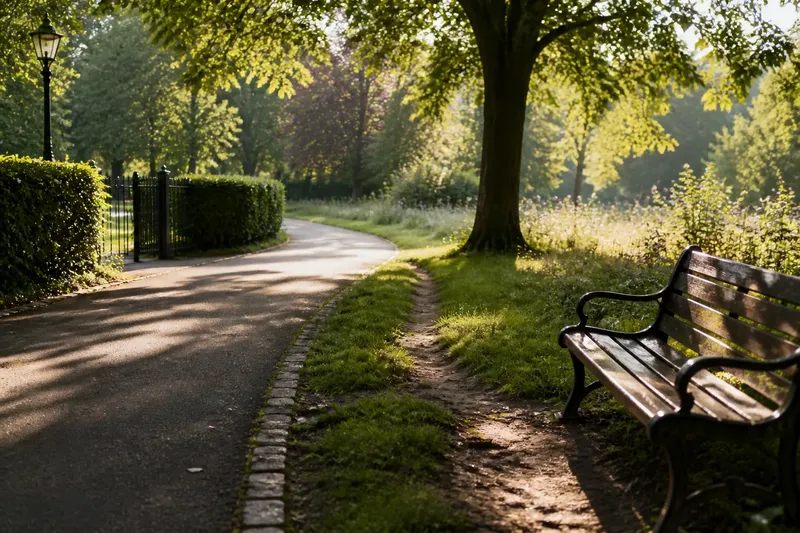
The most common mistake on a park visit is choosing a route before deciding what the hour is for. That can turn a welcome pause into an assignment: keep moving, cover ground, arrive somewhere. A park visit built around noticing offers a different measure of a good outing: what did the place reveal while you were there?
You do not need to identify every bird or plant. Let the park provide a loose sequence: a patch of light shifts across a path, a surface changes underfoot, or a gate opens and closes nearby. The point is not to keep your attention busy, but to notice what is already there without turning the visit into a task.
Choose a detail that gives the place a shape
Before setting off, choose one kind of detail to observe. It could be a boundary, a change in light, or the way people use a shared space. This is different from choosing a pace or mood: the detail gives your visit a subject, while you remain free to sit, walk, or leave it behind.
- Edges: Notice where a paved path meets soil, where a lawn ends at a hedge, or where shade gives way to sun. If the boundary is clear, compare what lies on either side; if it is not, follow another edge such as a fence or stream.
- Light: Check how a tree’s shadow falls across a bench or path. If its outline is easy to see, watch where it reaches; if clouds flatten the contrast, switch to color or shape.
- Wear: Look for polished spots on a railing, worn grass beside a shortcut, or scuffs on a low wall. If a mark suggests repeated use, notice where it leads; if its cause is unclear, describe the mark without guessing.
- Shared space: Observe how a path accommodates walkers, cyclists, and people stopping to talk. If the flow is easy to see, note where people yield or pause; if the path is busy, move to a place where you are not in the way.
- Small changes: Watch a leaf turn in the wind, a puddle reflect passing clouds, or a branch sway against a building. If the detail keeps changing, stay with it; if it remains still, choose something else nearby.
- Sound sources: Notice the contrast between a close sound and one farther away, such as footsteps and traffic beyond the park. If the contrast is comfortable to follow, compare them; if noise feels intrusive, shift to a visual detail or leave.
These are starting points, not categories you need to complete. A familiar place may offer more when you look at its margins than when you scan for a memorable centerpiece.
Read the park through its edges
Edges show how one part of a park meets another. A worn line through grass may connect two paths; a hedge may screen a playground from a quieter seating area. You can notice these transitions without deciding why they formed or treating them as a puzzle to solve.
Stay on public paths and keep a respectful distance from wildlife and other visitors. If a detail is beyond a barrier or close to someone’s private conversation, let it remain out of reach. Looking carefully does not require crossing a boundary.
Notice light, wear, and ordinary use
Light makes small features easier to compare. A railing can cast a striped shadow, while a sunny patch on a bench may look warmer than the shaded ground beside it. On an overcast day, the differences may be subtler; the shape of a path or the color of a surface can still hold your attention.
Wear is another record of ordinary use, though it rarely tells a complete story. A smooth patch on a handrail shows contact, but not who touched it or why. Describe what is visible and leave the explanation open. That restraint keeps observation separate from speculation.
People’s movement can also reveal how a space works. Notice where a path narrows, where cyclists slow down, or where visitors step aside to let a stroller pass. The focus is the shared arrangement, not the identity of anyone in it; avoid photographing strangers or following an individual as part of your walk.
Use weather and access to choose where to look
Weather changes which details stand out. After rain, reflections and darkened surfaces may be easier to see; in bright sun, shade lines may become more distinct. Wind can make leaves and hanging branches move, while a still day may draw your attention to shapes that usually go unnoticed.
Choose a spot that suits your access needs and the conditions. A level path, nearby seating, restrooms, or a familiar exit can make the visit more manageable. If a crowded or exposed area feels uncomfortable, move to a quieter accessible place or end the visit.
It is not worth carrying a full kit just to record every observation. A phone can stay in your pocket, and a notebook is optional. If an aid starts making you stop and document each detail, put it away and return to looking.
Give the visit a loose sequence
If an open-ended outing feels difficult to begin, choose a simple order: look at the park’s edges, compare a few surfaces, then watch how light or activity changes nearby. There is no need to spend equal time on each part or finish them all. Move on when a detail stops holding your interest.
Say you arrive at a neighborhood park and start beside a paved path. You notice a worn strip of grass connecting the path to a bench, then see that the bench is partly in shade. You follow the public path to view the worn strip from the other end, find that it meets a gate rather than another path, and decide not to cross the grass because it is wet. The result is a small observation about how the park’s edge is used, along with a clear choice to stay on the dry route.
When you are ready to leave, take one last look at the detail you chose. Has its appearance changed with the light, weather, or movement around it? If nothing has changed, that is still a useful observation: the visit need not produce a discovery to have been attentive.
What can you notice when the park feels ordinary?
What can I do if I cannot identify a plant or bird?
Describe its visible or audible qualities instead: the shape of a leaf, the direction of a quick movement, or the rhythm of a call. A precise description is enough; identification can wait.
What should I notice if the park seems unchanged?
Look at a boundary, a shadow, or a surface worn by use rather than searching for a dramatic change. If nothing shifts during your visit, simply noticing that steadiness is a complete observation.
How can I make this kind of visit work with a child?
Offer one prompt, such as finding where a path meets grass or spotting a shadow with a clear edge. Let the child choose whether to keep looking or move on, and avoid making the outing depend on finding a particular object.
What if the park is crowded or noisy?
Choose a quieter edge or focus on a nearby visual detail that does not require close observation of other visitors. If the noise remains unpleasant, a shorter visit or another setting may suit you better.
Let the park’s details set the scale
A park visit built around noticing needs no route, special skill, or impressive discovery. Choose a visible detail, keep your observations close to what you can actually see or hear, and let the setting guide how long you stay.
On your next visit, try the phrase park visit built around noticing as a reminder to look at one edge, mark, or change in light before moving on. A familiar place may become easier to read when you pay attention to how its small parts meet.