Solo or Group Walks: Choosing the Company for the Occasion
Solo or group walks feel different by design. Choose the right company for your mood, route, and available time, then make the outing easier to enjoy.
The common mistake with solo or group walks is choosing by habit instead of by the kind of attention you want that day. A walk meant for quiet can become a tiring exercise in conversation; a walk meant for company can feel oddly flat alone. Choosing deliberately makes it easier to settle into the pace and notice what you came out for.
Let the purpose of the walk choose its company
Walking alone gives your attention room to move without negotiation. You can follow a thought, take a quieter street, or pause at a view without turning the pause into a group decision. That can suit a day when you want a little mental space or simply prefer listening to footsteps and street sounds.
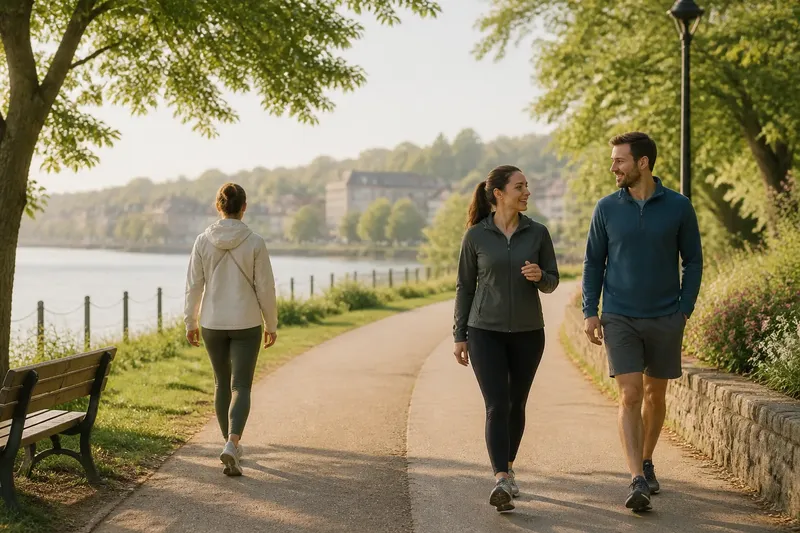
A companion changes the walk’s rhythm. Conversation may make a familiar route feel lively, while a shared destination gives the outing a natural focus. Group walking can also make it easier to keep going when you might otherwise cut the walk short, though that is only useful if the group’s pace and social energy suit you.
There is no need to assign one style to every walk. A quiet loop before work, a catch-up with a friend on the weekend, and a shared wander through an unfamiliar neighborhood can all belong in the same routine.
Use a week to make room for different rhythms
Think of the coming week as a set of invitations, not a fixed training plan. At the start of the week, notice which days are crowded with conversation and which leave you wanting company. Decide on the next walk in response to that, rather than treating every outing as an identical task.
- When you want quiet: Choose a familiar route and go alone. Keep the plan simple enough that you can leave your attention free of logistics.
- When you want a conversation: Ask one person to join you on a route with few complicated crossings. A steady, familiar path leaves less to coordinate.
- When you want shared discovery: Invite a companion to explore a place neither of you knows well. Agree that stopping to look around is part of the walk, not a delay.
- When your energy is hard to read: Keep a solo walk open-ended or make a short, low-pressure plan with someone nearby. Either choice allows the outing to remain manageable.
Say you have a free morning after a busy stretch of social plans and want some quiet, but a friend has asked to walk. You might take a short solo loop first, then arrange a separate neighborhood walk together later in the week. The observable result is a week with room for both silence and conversation, rather than asking one outing to supply both.
Set expectations before meeting up
A group walk works better when people share a basic idea of what it is for. Before setting out, say whether you hope to catch up, browse, or keep a brisk pace. You do not need a detailed itinerary; a clear expectation helps prevent one person from treating a leisurely wander as a march to a destination.
For a larger group, choose a route with obvious places to regroup, such as a public square, a park entrance, or a clearly marked trail junction. Decide who will wait if the group stretches out, and make sure everyone knows the intended endpoint. These small agreements keep attention on the company rather than repeated uncertainty about where to go next.
It is also fine to make conversation optional. A friend can walk beside you without filling every pause, and a group can agree that stretches of quiet are welcome. Shared presence does not require constant talk.
Choose a route that supports the social mood
For a one-to-one conversation, a familiar loop or broad path can be easier than a route that demands frequent navigation. Side-by-side walking often feels more relaxed than sitting face-to-face, and a known route means both people can give their attention to the exchange.
For shared discovery, choose somewhere with things worth responding to together: a public garden, a waterfront path, or streets with varied storefronts and architecture. The point is not to collect sights. It is to let the surroundings offer natural pauses and subjects when conversation runs dry.
For solitude, a route you know can reduce small decisions and let your mind settle. If you prefer an unfamiliar walk, check the route before leaving so you are not repeatedly reaching for directions. Keep route choices within your comfort and ability, and follow any posted local guidance where it applies.
Not worth the effort: trying to make every walk socially memorable. A simple lap with a friend can be satisfying without a special destination, a group photo, or a carefully planned topic.
Which kind of walk fits this moment?
Is walking alone better for clearing your head?
It can be, especially if conversation would compete with the quiet you want. Choose a route that feels easy to follow, then let the walk be unstructured rather than expecting a particular thought or mood to appear.
How do I invite someone without making the walk feel like an obligation?
Offer a clear, low-pressure plan: name a meeting place, a general route, and that it is fine to keep it short. A specific invitation is easier to accept or decline than an open-ended expectation.
What if our walking paces are different?
Choose a route where you can comfortably regroup, and agree that nobody has to keep up at the cost of enjoyment. If pace is central to one person’s purpose and conversation is central to the other’s, separate walks may be kinder than forcing a compromise.
Can a group walk include quiet time?
Yes. Mention before setting out that you are happy to walk together without talking continuously, or suggest a route with natural stretches of quiet. That small clarification can make companionship feel less demanding.
Adjust the plan after the walk
Afterward, notice what felt good: the freedom to change direction, the ease of a conversation, or the pleasure of spotting something alongside another person. Also notice what felt mismatched, such as a route that made talking awkward or a group that moved faster than you wanted. Treat those observations as useful preferences, not verdicts on walking alone or together.
For solo or group walks, the useful choice is the one that fits the attention you have available and the company you actually want. Let the next outing respond to that. A week can hold quiet miles, an easy catch-up, and a shared discovery without requiring one style to become your permanent favorite.